I’ve studied King Benjamin’s famous sermon in Mosiah 2-5 many times. It’s a section of scripture with profound spiritual depth and breadth; the source of many favorite scriptures and doctrines that I have revisited many times. In light of global circumstances, a new verse lodged in my mind while studying last week.
After sharing his prophecy of the Savior’s birth, life, and death as taught to him by a visiting angel, King Benjamin says this:
Mosiah 3:13 And the Lord God hath sent his holy prophets among all the children of men, to declare these things to every kindred, nation, and tongue, that thereby whosoever should believe that Christ should come, the same might receive remission of their sins, and rejoice with exceedingly great joy, even as though he had already come among them.
I’ve been particularly drawn to this portion: “The same might receive remission of their sins, and rejoice with exceedingly great joy, even as though he had already come among them.”
Note that at the time, the people are just over a century away from Christ’s birth. This stuck with me because of all the chatter about the Second Coming and the end of the world when COVID-19 suddenly arrived in North America and stopped Western society in its tracks. Many Christians, including Latter-day Saints, seemed quickly charged with a collective excitement, something to the effect of, “Maybe this is it, time for Jesus to come back!” Data seems to back it up: Around March 28, 2020, there was a large spike in Google searches including the word “Apocalypse”:
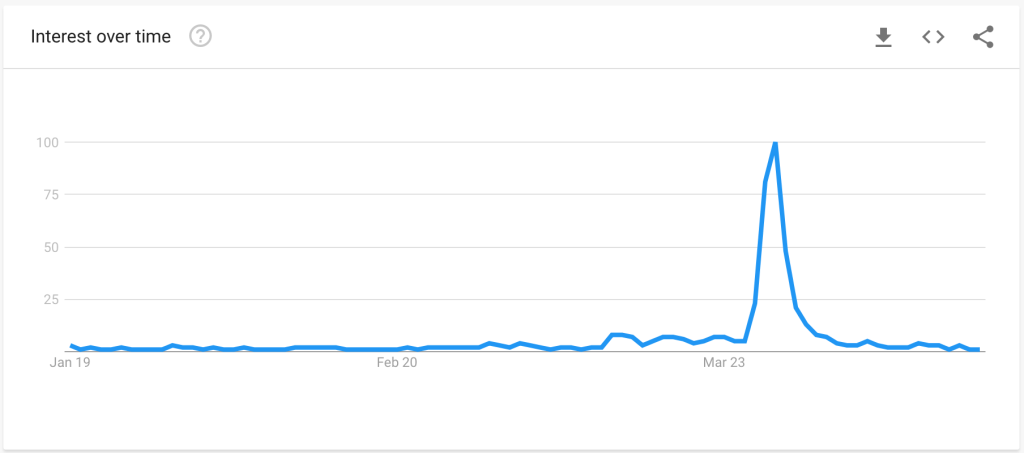
It’s a bit humorous; at least interesting in light of human nature. One term for preoccupation with the end of the world is, “eschatological anxiety.” (And if you don’t think we have a preoccupation, check the storylines of the top grossing movies of the last five years.)
Certain events hit us with great force, knocking us off balance, upsetting the status quo. This is actually happening to some people in their own way every day, but the effect is magnified as the number effected increases. Combined with plenty of scriptural prophecy of bad things happening in the future and a group of people sincerely excited for their Lord and King to come take his rightful place, and this response is not surprising. (I won’t claim that I haven’t got excited at the thought. I believe in Christ and his eventual return, and frankly I long for the day that I get to see him.)
In my short life I’ve seen that many large-scale calamitous events get a number of people thinking this way. “Maybe this is it! The end is nigh!” It happened to some degree at the turn of the millennium with concerns over the Y2K bug, and I remember it happened in 2001 with the 9/11 Terrorist attacks. I was a missionary in Chicago. And to be fair, it did feel like the end of the world.
Fair enough. Technically we’re closer to the Second Coming every day than we were the day before, right?
But a funny thing happens in the aftermath of these events, another interesting part of human nature: things normalize. We regain equilibrium and a new status quo. It happened in the aftermath of Y2K and 9/11 and it is already happening in many ways in the wake of COVID-19. Suddenly it doesn’t seem as apocalyptic as it once did. Add a General Conference where in large measure the Prophets invited Church members to keep on keeping on, and suddenly all that Second Coming talk fades pretty quickly.
I’m in the camp of Author John Green’s college theology professor Donald Rogan, who once told him, “Never predict the end of the world. You’re almost certain to be wrong, and if you’re right, no one will be around to congratulate you.”
I think that’s great advice. Our beliefs can bring us dangerously close to having a weird sort of gladness in catastrophe because it seems to bring us closer to events we long for. But my point is not so much that we shouldn’t hope for the the Second Coming or work hard to prepare the world. Scriptural accounts of people looking forward to the Birth of Christ are a powerful analog for Latter-day Saints looking forward to the Second Coming, and King Benjamin’s point, as made elsewhere (Jacob 4:4), was that it doesn’t matter if we live when the Savior is around. The Atonement of Christ is infinite. He isn’t confined to place and time!
In fact, it appears to me that thinking we can’t find personal peace and joy in the modern world without the Savior coming to bail us out effectively cuts short the power of Christ in our own lives. Consider again what king Benjamin said:
“Whosoever should believe that Christ should come, the same might receive remission of their sins, and rejoice with exceedingly great joy, even as though he had already come among them.”
Christ himself was adamant that his presence wasn’t essential. In fact, he emphasized (to the confusion of his disciples) that his absence was essential, because it is the role of the Holy Ghost to bring peace, comfort, healing, and a remission of our sins. John 14 records the conversation, where the Apostles struggle to wrap their heads around the impending departure of Christ:
At one point Phillip says, “Lord, show us the Father, and it sufficeth us.”
As part of his response, Jesus stresses these facts:
15 If ye love me, keep my commandments. 16 And I will pray the Father, and he shall give you another Comforter, that he may abide with you for ever; 17 Even the Spirit of truth; whom the world cannot receive, because it seeth him not, neither knoweth him: but ye know him; for he dwelleth with you, and shall be in you.
And later:
25 These things have I spoken unto you, being yet present with you. 26 But the Comforter, which is the Holy Ghost, whom the Father will send in my name, he shall teach you all things, and bring all things to your remembrance, whatsoever I have said unto you. 27 Peace I leave with you, my peace I give unto you: not as the world giveth, give I unto you. Let not your heart be troubled, neither let it be afraid.
I fear that too often I don’t fully appreciate the Holy Ghost in my own life and circumstance. It is by the Holy Ghost that we receive the full blessings that the Savior offers. This truth is so fundamental that it is denying the Holy Ghost, not denying Christ, that sits at the pinnacle of the most grievous mistakes we could ever make!
Jesus Christ is far too powerful and far too effective to be constrained by calendars and task lists, whether personal or universal. We are promised every week that if we will keep his commandments we can have his spirit to be with us. We are promised joy in any circumstance through our faithfulness. Sure, it will be glorious when the world is cleansed and Eden is regained. Make no mistake, I believe in the eventual Second Coming and all the awesomeness that we believe will follow. But happiness in paradise isn’t as impressive, is it? The real power, the real miracle, is peace and happiness now, when Eden the world ain’t! That’s the miracle Christ promises.
Perhaps most sobering of all is this: While humanity marches on, in and out of calamity and prosperity, through tragedy and triumph into a hazy future, any given moment is in fact the end for a Child of God somewhere. Our personal end, forgive me, is always nigh.
So while we look forward to the Savior tomorrow, let’s not forget what he offers us today.
Dig deeper:
David A. Bednar, That we may always have his Spirit to be with us
 Brigham Rupp
Well done Brigham…
LikeLike