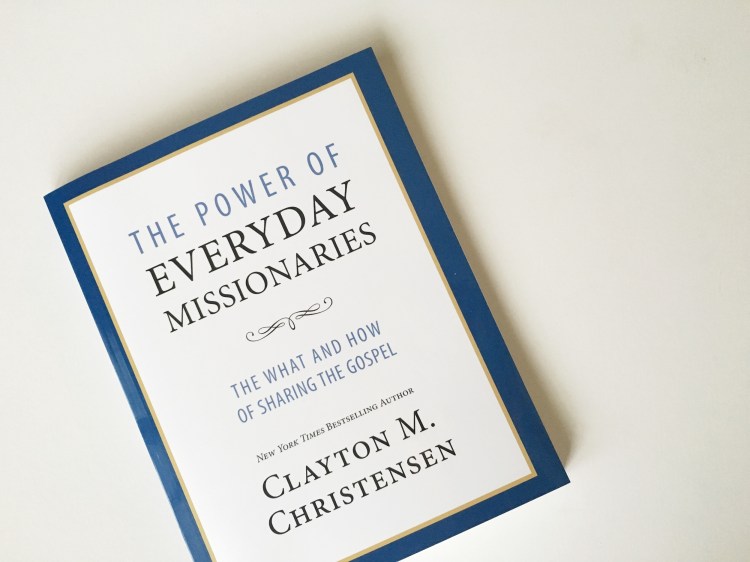
This is the first of what I hope will become a series of periodic book recommendations. When I started this blog, I never intended to review books but I thought it might be fun as a repeated feature. While I love to read, I don’t read a lot of “Church” books. I’m busy, they’re expensive, and, I tend to stick with the scriptures for my gospel study. (This started years ago when I saw this statement by Marion G. Romney: “I don’t know much about the gospel other than what I’ve learned from the standard works. When I drink from a spring I like to get the water where it comes out of the ground, not down the stream after the cattle have waded in it. … [Coordinators’ Convention, Seminaries and Institutes of Religion, 13 Apr. 1973.] This idea of “drinking from the source” stuck, and I’ve always been a little wary of “downstream” sources when it comes to gospel study.) This is not to say that there aren’t great books aside from the scriptures. There are. There are a handful of books that have really helped me better understand and live the gospel, but LDS writing is a whole industry now, and the quality varies.
This brings me to a couple of months ago when I started to receive strong and frequent spiritual impressions on the subject of sharing the gospel. I can’t remember the impetus, but I began to have consistent impressions that it was time to repent of my sloth, both as an individual and as a bishop, in this area. While pondering these impressions, I thought of a book that I had seen: The Power of Everyday Missionaries, By Clayton M. Christensen. I was vaguely familiar with Brother Christensen; his status as a respected professor at Harvard and as a New York Times best-selling author lent some credibility, but I hadn’t given the book much thought. On the challenging topic of missionary work, I dismissed it as probably another failed effort to find the silver bullet that would magically make missionary work simple and easy. But I had changed; now I was hungering for insight and guidance into being a better missionary, so I took a closer look. First, I found a lot of positive reviews. Five stars does not a good book make, but I was intrigued. I also found that all proceeds from physical sales were being donated to the Church missionary fund and thatthe ebook version was free to download. That was something I could get behind. I downloaded a copy.
The Power of Everyday Missionaries is not Brother Christensen’s interpretation of doctrine, nor is it an oversimplified cure-all. The book is primarily a collection of observations regarding our approach to missionary work. Christensen points out some bad habits, mistaken assumptions, and failed attempts, but far from dwelling on the negative, he offers many simple suggestions for improvement. What makes Christensen an authority on the topic? Almost all of his observations are based on his own experience as someone who has tried very hard to be a faithful missionary for decades. We’re talking about someone who, according to his book, has had at least one person take the missionary lessons every year for the past twenty years. He also writes a lot from experience as an area authority in the Northeast. In this way the book is also a sort of missionary memoir because he uses his years of experience to make his points, but the focus is never on Christensen. The focus is squarely on helping members have more effective and meaningful missionary experiences.
I like the book quite simply because it not only inspired me to be a better missionary, but it actually made me excited to try. It’s full of practical, simple ideas for both individuals and wards, and for the most part they feel logical, natural, and most importantly doable without demanding drastic changes in our personalities, relationships, or daily lives. Rather than feeling overwhelmed, I felt I could be much better by making a few small changes in my attitude and actions. It was one of the few studies of missionary work that has given me more hope and excitement than guilt. Here are a few of the observations and ideas that stuck with me:
- Treat every invitation as a success. Rejection is not failure.
- As members, we can be much more open and honest about who we are and what we do with our time. We can be less guarded in our everyday conversation.
- We should invite successful, content people to help the Church, rather than only inviting down-and-out people to receive help from the Church.
- We often try to give people what we think they need, rather than what they want. (We get doctrinal when all they want initially is a place to be edified, make friends, and give meaningful service).
- In our callings, we tend to do what has always been done. We can be much more creative and innovative.
- We need to have wards and church meetings that are actually enjoyable to attend. if we don’t enjoy church meetings, why would we invite our neighbor?
I finished the book a few weeks ago and these are all off the top of my head, so some of the ideas stuck pretty well. I recorded even more in my notes. Perhaps you’ve already thought of all these ideas, but if you’re like me, you’d be hard-pressed to read the book without wanting to jotting down a few things to do in your personal, family, and church responsibilities. It’s short, easy, and free (for the ebook), so there’s not much to lose other than a little time.
As we move further into the last days, it feels like there’s a new frontier of missionary work that the Lord is waiting for us to open up. If nothing else, there’s a new frontier he’s asking me to open up. More on this topic next time!
If you’ve read The Power of Everyday Missionaries or if you choose to take a look, please share your thoughts. I’m curious what others have to say.
Buy or download The Power of Everyday Missionaries at DeseretBook.com. Learn more about the book here: http://www.everydaymissionaries.org.
 Brigham Rupp