Baptismal interviews with children are one of the highlights of serving as a bishop. Their simple faith and innocence is so refreshing. I have great respect for the apprehension, excitement, and desire they bring to the interview and their sincerity in answering the questions.
The baptismal interview is the first time we are asked a series of questions that, if we continue faithful, we will encounter every few years for the rest of our lives. These questions do not assess our perfection, but provide an opportunity for reflection and accountability upon a baseline of worthiness before the Lord. One of my favorite interview questions with the children is this: “Are you honest in your dealings with your fellow men?” Children don’t always understand exactly what is being asked, so I usually ask a follow up question such as, “Do you always tell the truth?” The response is the same from nearly ever child. They humbly admit, “No, not always.” Such an ironically honest confession! I was struck years ago when I first really thought about what it means to be honest. Opportunities to be dishonest are so prevalent, varied, and so subtle that I also had to admit, “No, not always.”
Few things are as universally condemned in the scriptures as dishonesty. The judgments are plain and severe. For example, “Wo unto the liar for he shall be thrust down to hell,” said Jacob (2 Nephi 9:34). Meanwhile Satan insists, “There is no harm in this…” (2 Nephi 29:8). We ought to be careful who we heed. Of all he could’ve been called, Lucifer was given the name The Father of Lies, no doubt because of the coup he attempted on the back of the oldest lie of all, “here am I, send me, I will be thy son, and I will redeem all mankind, that one soul shall not be lost” (Moses 4:1-4, 2 Ne. 9:9). Sometimes we talk about Lucifer’s “plan” as if it were a viable option that God rejected. In reality, it is the earliest lie on record.
Despite the scriptural clarity on the subject, there is a risk as we grow into adulthood that we come to tolerate a certain level of dishonesty. While we may consider ourselves honest in general, do we sometimes settle into a mistaken belief that some dishonesty is acceptable? Supposedly harmless deception even has a name: “white lies.” When confronted by our own dishonesty, our tendency is to justify our actions. In seminary for example, the topic of honestly inevitably leads to a game of “What if?” where my students work hard to tease out the exceptions to the commandment. The go-to scenario is always, “What if someone asks me if their clothes make them look fat?” I’m not sure why this is the classic question that justifies lying, but I hear it all the time.
Are there times when deception is justified? Probably so. There are a number of apparently God-mandated deceptions in the scriptures. (Abraham telling the Egyptians that Sarah was his Sister; Nephi posing as Laban, to name a couple.) Maybe being honest doesn’t equate directly to always telling the truth, but that’s not the point. The risk is justifying dishonesty that is so often motivated by fear, pride, greed, shame, laziness, etc.
When the “what-ifs” arise, I ask the teenagers the same thing I ask the children in those baptismal interviews. “Do you think we ever have to lie?” Of course the answer is no. Then we have a discussion about what useful things we might say, besides lying, to a friend who asks something like, “Does this make me look fat?”
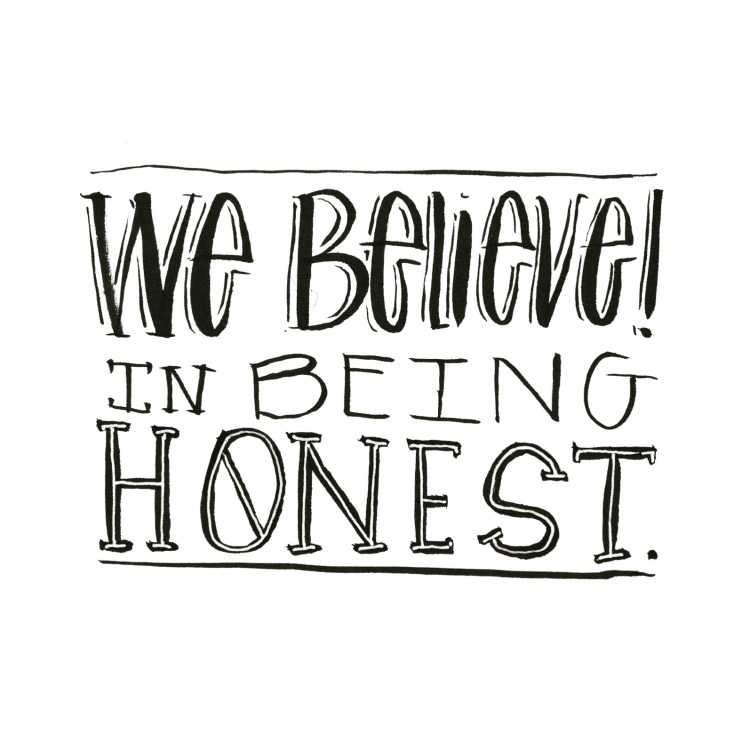
How would the world at large change if everyone were honest? It boggles my mind to think of it. Global honesty may be a pipe dream, but even among Church members, imagine the impact if we more carefully followed the mantra, “We believe in being honest!” Dishonesty is behind so much of the heartache, confusion, and wasted time in the world and in the Church. Dishonesty is like sand in the gears of the work of the Lord. It destroys trust in others, erodes respect for self, and leads to very real captivity.
In the early days of the Church, the Lord revealed the following to Church members through the prophet Joseph. Notice the blessings promised to the obedient:
17 Wherefore, I, the Lord, have said that the fearful, and the unbelieving, and all liars, and whosoever loveth and maketh a lie, and the whoremonger, and the sorcerer, shall have their part in that lake which burneth with fire and brimstone, which is the second death. 18 Verily I say, that they shall not have part in the first resurrection. 19 And now behold, I, the Lord, say unto you that ye are not justified, because these things are among you. 20 Nevertheless, he that endureth in faith and doeth my will, the same shall overcome, and shall receive an inheritance upon the earth when the day of transfiguration shall come; 23 But unto him that keepeth my commandments I will give the mysteries of my kingdom, and the same shall be in him a well of living water, springing up unto everlasting life. (D&C 63:17-20, 23)
I can’t pretend to have the magic formula for perfect honesty in every situation. When you start to really think about what it means to be honest, it is perhaps one of the most nuanced of the fundamental commandments. The honesty injunction is not an excuse to be blunt, thoughtless, or mean. Nor is it an excuse to jettison propriety and confidentiality or to spray unnecessary “truth” all over everyone around us without regard.
How then can we hope to be truly honest in our dealings with our fellow men? By following the promptings of the Holy Ghost. I know that the Spirit always ratifies my honesty, always warns me before I choose to deceive, and always departs when I make the wrong choice. As we heed the Spirit’s promptings and consistently choose to be honest, we gain the priceless spiritual currency of integrity. The commandment to be honest is an invitation to simply be true, just as the Savior is. Imagine, just for a moment, that the Savior were not 100% completely honest, and therefore you could not with surety always trust him (See Ether 3:12). Destroys the entire plan, doesn’t it? Such as the power of honesty.
…
Thanks for reading! Please share your thoughts in the comments; there’s a lot to this topic and I’d love to have your insight. If you like what you’re reading, please share with a friend! Remember you can get updates by following the blog on Twitter, Facebook, and Instagram @thesilvergrey.
More Scriptures on the topic:
- D&C 10:25–26
- D&C 76:103–6
- D&C 42:21
- Alma 27:27
- Exodus 20:16
- Matthew 19:18
- For even more relevant scriptures, see Honesty, Lying, Integrity, and Deceit in the Guide to the Scriptures.
There are a number of classic talks on the subject, and they all say it better than I did.
- This is No Harm – Marvin J. Ashton
- Honesty—a Moral Compass – James E. Faust
- Honesty, a Principle of Salvation – Mark E. Petersen
- Honesty and Integrity – Delbert L. Stapley
- Ethics and Honesty – David B. Haight
- Without Guile – Joseph B. Wirthlin
- Integrity – Carol B. Thomas
- “An Honest Man—God’s Noblest Work” – Gordon B. Hinckley
- Integrity – N. Eldon Tanner
- “We Believe in Being Honest” – Marion G. Romney
 Brigham Rupp
Loved reading this; Definitely did some self evaluation while doing so!
LikeLike